


On the Curious Tendency of Memorable Names to Arrange Themselves in Threes, with Some Observations Concerning Rhythm, Speech, Memory, and the Naming of Enterprises
Abstract
Certain names stay with us. They are easily spoken, readily remembered, and peculiarly satisfying to hear. Others, although perfectly serviceable on paper, seem to possess none of this adhesive quality.
For many years I have observed a recurring characteristic among the former: an extraordinary number of successful commercial names, public names, institutional names, and advertising expressions consist of three syllables or resolve, when spoken, into a rhythmic pattern of three — or triplets.
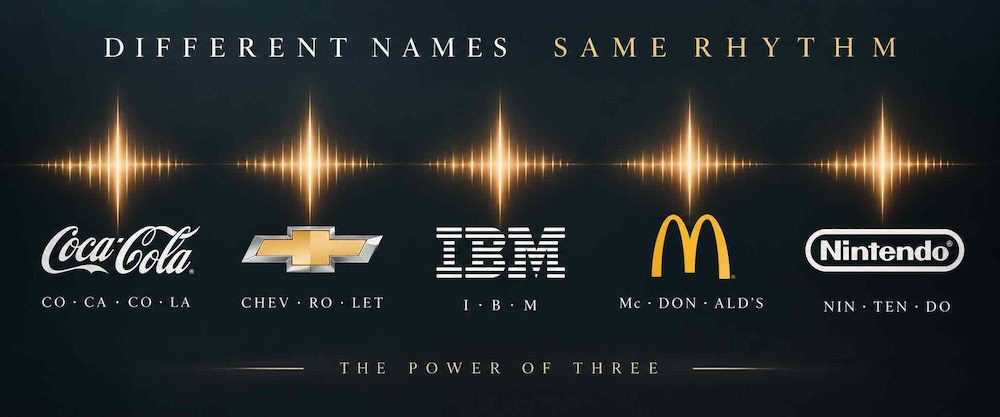
Chevrolet. IBM. Nintendo. Verizon.
The phenomenon extends beyond literal trisyllables. Names containing two, four, or more syllables frequently compress or expand in ordinary speech until three principal pulses emerge. Some syllables become subordinate, almost ornamental. Others are elongated. Stress rearranges the apparent architecture of the written name.
This suggests that a name possesses two forms: its form upon the page and its form in time.
The latter may prove considerably more important.
The following is an abbreviated presentation of a larger theory I am developing concerning trisyllabic names, triplet rhythms, monosyllabic impact names, and the relationship among naming, rhythm, speech, and human memory.
The Name We Hear
Most discussions of names begin with meaning.
What does the name signify? What associations does it produce? Is it distinctive? Can it be trademarked? Does it communicate the appropriate position? Does it look handsome in a logo?
These are useful questions. There is another question that interests me considerably more: What happens when somebody says it?
A name is a sequence of sounds occurring in time. Before typography, logos, trademarks, search engines, and domain names entered the picture, names were spoken. We heard them. We repeated them. We taught them to other people.
And human speech has rhythm.
This elementary fact becomes remarkably interesting when one begins examining the names that have achieved unusual prominence.
Consider:
- Chevrolet.
- Three syllables.
- IBM.
Three spoken letters. Three beats.
Nintendo.
Three syllables.
Verizon.
Three syllables.
Now leave corporations and consider people whose names themselves became valuable public properties:
Donald Trump.
Gene Simmons.
Ronald Reagan.
Steve Jobs.
The arithmetic immediately presents a problem. Some of these names contain three syllables; others plainly do not.
Yet listen to them rather than count them.
Something else is happening.
The distinction I propose is between syllabic structure and rhythmic structure.
A word may contain a certain number of syllables according to ordinary linguistic analysis while behaving quite differently in actual speech. Strong stresses establish principal beats. Weak syllables are compressed. Sounds glide into one another. A short syllable can be elongated. A longer group can be dispatched almost instantaneously.
The dictionary counts syllables.
The ear experiences time.
That difference may be fundamental to memorable naming.
The Triplet
Music provides a useful vocabulary for describing what I mean.
A triplet divides a beat into three rhythmic units. The attraction of the triplet here is not that names literally become musical passages. Rather, musical notation gives us an unusually precise way of representing something ordinary spelling conceals: duration.
Consider Ronald Reagan.
Written out, the name contains more material than a neat trisyllable. Spoken naturally, however, the weak portion of “Ronald” can be passed over quickly:
RON-(ald) RAY-gan
The parenthetical syllable remains audible, yet it carries comparatively little rhythmic weight. It resembles, in function, a musical grace note: present, meaningful, but subordinate to the principal rhythmic structure.
I use “grace syllable” provisionally for this phenomenon.
The idea deserves careful linguistic treatment because it gives us a way of explaining why certain names feel shorter and cleaner than their syllable counts suggest.
The opposite operation also occurs.
A short name can be expanded through duration and stress. “Steve Jobs” consists of only two syllables, yet the long vowel of Steve and the hard terminal force of Jobs give the name considerable rhythmic breadth. Its spoken duration exceeds what a mere syllable count would predict.
The Rolling Stones provide another useful case. In ordinary reference, they are very often simply “the Stones.” A monosyllabic noun can nevertheless occupy a substantial rhythmic space when spoken, announced, or chanted.
We therefore have at least three variables:
- syllable,
- stress, and
- duration.
Once those variables are separated, a much richer theory of naming becomes possible.
Why Three?

There is ample reason to investigate three as a unit of human communication.
Rhetoric has employed triadic constructions for centuries. Speakers instinctively group propositions in threes. Advertising slogans repeatedly do the same.
“Just Do It.”
Three words. Three clean strikes.
“It Just Works.”
Again, three.
The attraction extends into ordinary memory.
Consider the American telephone number.
Someone tells you: 824
You can generally retain it immediately.
Or: 717
Again, remarkably easy.
Then come four additional digits, and suddenly the little act of memory becomes more demanding.
Telephone numbers are conventionally chunked into groups, and cognitive psychology has long studied the role of chunking in working memory. My interest lies in something more specific within that larger phenomenon: the possible interaction between chunking and rhythm.
Three digits are readily vocalized as three discrete events:
Eight. Two. Four.
Seven. One. Seven.
The group becomes almost a miniature verbal performance.
This does not establish that three possesses some universal superiority over every other possible grouping. It does give us an everyday example of the larger question: whether certain compact rhythmic structures are unusually congenial to human speech and auditory memory.
That question deserves investigation.
The Corporate Ear
Commercial naming provides an enormous laboratory.
Some names arrive already arranged into three clear units. Others acquire their rhythm through abbreviation.
International Business Machines is formidable.
IBM is effortless.
Three enormous words have been compressed into three tiny spoken units: I. B. M.
The semantic information has almost disappeared, while the rhythmic identity has become exceptionally strong.
The same phenomenon appears in ABC, BBC, MGM, and UPS.
This suggests something important about abbreviation. An abbreviation does more than shorten a name. It can recompose its rhythm.
A corporation may begin with a descriptive designation and eventually discover that the public prefers a compact phonetic object.
Branding, viewed this way, becomes partly an evolutionary process. Usage tests the name millions of times. Customers shorten it. Employees abbreviate it. Advertising regularizes its pronunciation. Familiarity smooths awkward edges.
Eventually the surviving form may bear surprisingly little resemblance to the formal name with which the enterprise began.
The market has edited the rhythm.
Apple and the Evolution of a Name

Apple presents an especially interesting case because the corporate name itself is bisyllabic.
Apple.
It is soft, simple, and memorable, yet it does not satisfy a literal trisyllabic rule.
Now follow the company through some of the names by which its products became known:
Apple II.
Apple Mac.
iMac.
iPod.
iPhone.
OS X.
The examples differ considerably in literal syllable count, but they demonstrate how product naming can create new rhythmic identities around an established corporate name.
Even the name Steve Jobs deserves examination. It possesses only two syllables, yet its vowel duration, stresses, and hard closure give it a force that two dots on a syllable chart would never reveal.
This is precisely why syllable counting alone cannot carry the theory.
We must hear the name.
The Other Extreme: The Punch

There is another class of successful name that operates according to an almost opposite principle.
The monosyllabic name.
Ford.
Kiss.
Shell.
Prince.
Vogue.
These names derive their strength from compression. There is no elaborate cadence because virtually the entire identity arrives at once.
Yet monosyllabic names vary enormously in force.
Here phonetics becomes especially important. Attack, vowel quality, consonant weight, and terminal closure determine whether the single syllable strikes the ear or simply passes through it.
“Kiss” has an initial consonant attack and a sharp terminal hiss.
“Ford” closes firmly.
“Jobs” ends with considerable weight.
The monosyllabic name therefore deserves treatment as a separate architecture rather than as an exception requiring apology. If the triplet works through rhythm and resolution, the monosyllable can work through concentration.
One unfolds.
The other strikes.
Names as Performances
This leads to what I believe may be the larger principle behind the entire observation.
A successful name is frequently a performable name.
It survives being spoken.
It tolerates repetition.
It can be announced.
It can be advertised.
It can be remembered after hearing it once.
It can pass from one person to another with remarkably little friction.
And, in certain cases, it can be chanted.
These characteristics connect naming with several established fields of inquiry: prosody, psycholinguistics, phonetics, rhetoric, cognitive psychology, mnemonics, sound symbolism, advertising, and the psychology of memory.
Prosody is particularly important because it concerns precisely those qualities that ordinary spelling leaves poorly represented: stress, timing, intonation, and rhythm.
Cognitive psychology supplies another part of the picture through its study of chunking and working memory.
Rhetoric supplies centuries of evidence concerning the peculiar durability of triadic expression.
Advertising provides an immense body of practical experimentation conducted in the marketplace, where phrases survive largely because people can retain and repeat them.
These disciplines approach different questions. Yet their borders meet at an intriguing point: Human beings remember language partly as patterned sound.
If that proposition holds, naming should be studied accordingly.
Toward a Rhythmic Theory of Naming
The theory I am developing therefore extends considerably beyond the proposition that “three-syllable names work.”
That is the observation from which the inquiry begins.
A fuller taxonomy may include at least the following forms:
The pure trisyllable: a name containing three clear syllables.
The three-beat acronym: a sequence such as IBM in which three letters become three spoken units.
The rhythmic triplet: a name whose literal syllable count differs from three but whose ordinary pronunciation resolves into three principal pulses.
The compressed form: a longer name containing subordinate or “grace” syllables that pass rapidly between principal stresses.
The elongated form: a shorter name whose vowel length, stress, or performance gives it greater rhythmic duration.
The impact monosyllable: a highly compressed name whose phonetic construction supplies force in place of rhythmic development.
These categories remain subjects for refinement. Musical notation may eventually provide a useful method for representing them. Triplet marks, ties, grace notes, and note duration can show visually what typography alone cannot: how long a sound occupies the ear and where its stress falls.
That notation should serve the linguistic observation rather than turn the discussion into a lesson in music theory. Its purpose is simple.
A printed name exists in space.
A spoken name exists in time.
We have spent an extraordinary amount of effort studying the former.
The latter deserves considerably more attention.
The Test
There is a simple exercise that illustrates the point.
Take the name of a corporation, product, entertainer, public figure, or institution that you consider exceptionally memorable.
Forget the logo.
Forget the typography.
Forget the meaning for a moment.
Say the name aloud.
Listen for the principal stresses.
Notice which syllables receive full weight and which glide between them. Notice where the vowels lengthen. Notice where consonants stop the sound. Notice whether the name divides naturally into three pulses, whether it compresses into a single strong blow, or whether some other rhythmic structure emerges.
Then try another.
And another.
Once one begins listening to names in this fashion, an interesting feature of language becomes difficult to overlook.
Names have rhythm.
And some rhythms appear remarkably well suited to being remembered.
Comments are closed.